
Connecting Patients and Care: How a Coordinated Platform Approach is Modernizing German Healthcare
June 11, 2026
Amsterdam, June 11th, 2026 - The German healthcare system is undergoing a fundamental shift. Hospitals are navigating two growing pressures. Patients expect transparent communication, digital access to their health data, and seamless online experiences. Meanwhile, clinical staff face an increasing administrative burden that grows with every new requirement, regulation, and reporting obligation. Going digital is no longer optional. It is the only way to meet modern patient expectations while keeping the system workable for the people who run it.
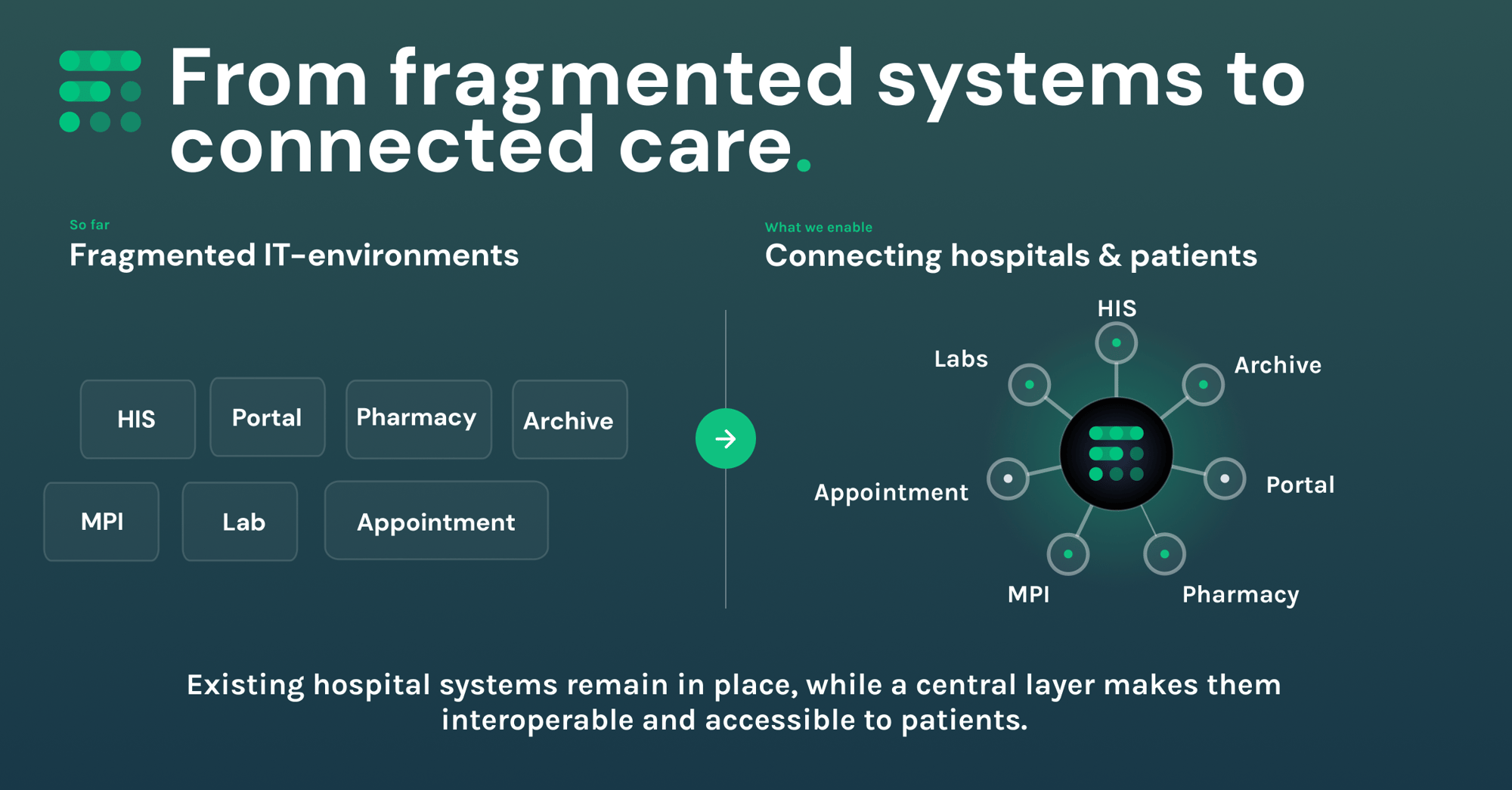
Yet behind the scenes, the reality is often different. Many hospitals operate within fragmented IT landscapes: a multitude of core clinical systems that don't natively communicate, paper-based and semi-digital workflows, and siloed data that rarely reaches the patient or supports the clinical team in their day-to-day work.
We recently saw this firsthand in our collaboration with the Sozialstiftung Bamberg (SSB). The project was designed to build a unified digital bridge between existing hospital IT infrastructures and modern patient services. It was realized under the German Hospital Future Act (KHZG), funding category 2, dedicated specifically to patient portals built on interoperable foundations. Together with Philips as prime contractor, Founda Health providing the interoperability backbone, and our partners Timerbee (Appointment Booking) and Logex (Patient Portal), we established a central orchestration layer that connects proven clinical systems with user-friendly digital touch points.
The Challenge: A Complex Multi-Vendor Landscape
Digital transformation in German hospitals comes with a unique set of hurdles that increase the complexity of interoperability focused projects:
Multi-vendor clinical IT. The SSB, as many other hospitals, operates a diverse set of established clinical systems, spanning imaging, patient administration, rehabilitation, and specialist workflows, each domain served by dedicated systems, optimized for their specific clinical purpose rather than cross-system data exchange. The challenge was to connect these systems without building fragile point-to-point interfaces. Data needed to be made available across the whole organization where it is needed and without rebuilding what already works.
Patient Identity Silos. With patient data managed independently across multiple systems, establishing a single, unified patient record is technically demanding. Duplicate records and registration gaps require active data governance and not just a one-time fix. The SSB already introduced a Master Patient Index (MPI) provided by the i-engineers prior to the project, tackling exactly this hurdle and making it possible to build the interoperability layer based on reliable patient information.
Vendor Orchestration. Real interoperability means coordinating not just four partners, but a web of systems and organizations. Each with their own release cycles, escalation paths, and constraints. This is where most digital projects in healthcare stall.
The Solution: One Coordinated Rollout
The project was structured as a single coordinated program under Philips, with Founda, Logex, and Timerbee as an integrated delivery team. This helped to focus and coordinate activities across the project journey and also enabled us to react and adapt to external factors as one team with one clear escalation path. Especially highlighting the relevance of accountability in settings with multiple involved system providers.
This is particularly evident in projects involving multiple system vendors: interoperability is not merely a technical challenge, but above all a matter of clear accountability and coordinated collaboration.
For our project, this meant four organizations working towards one outcome:
- Philips as prime contractor, owning the overall delivery, change management, and holistic project management
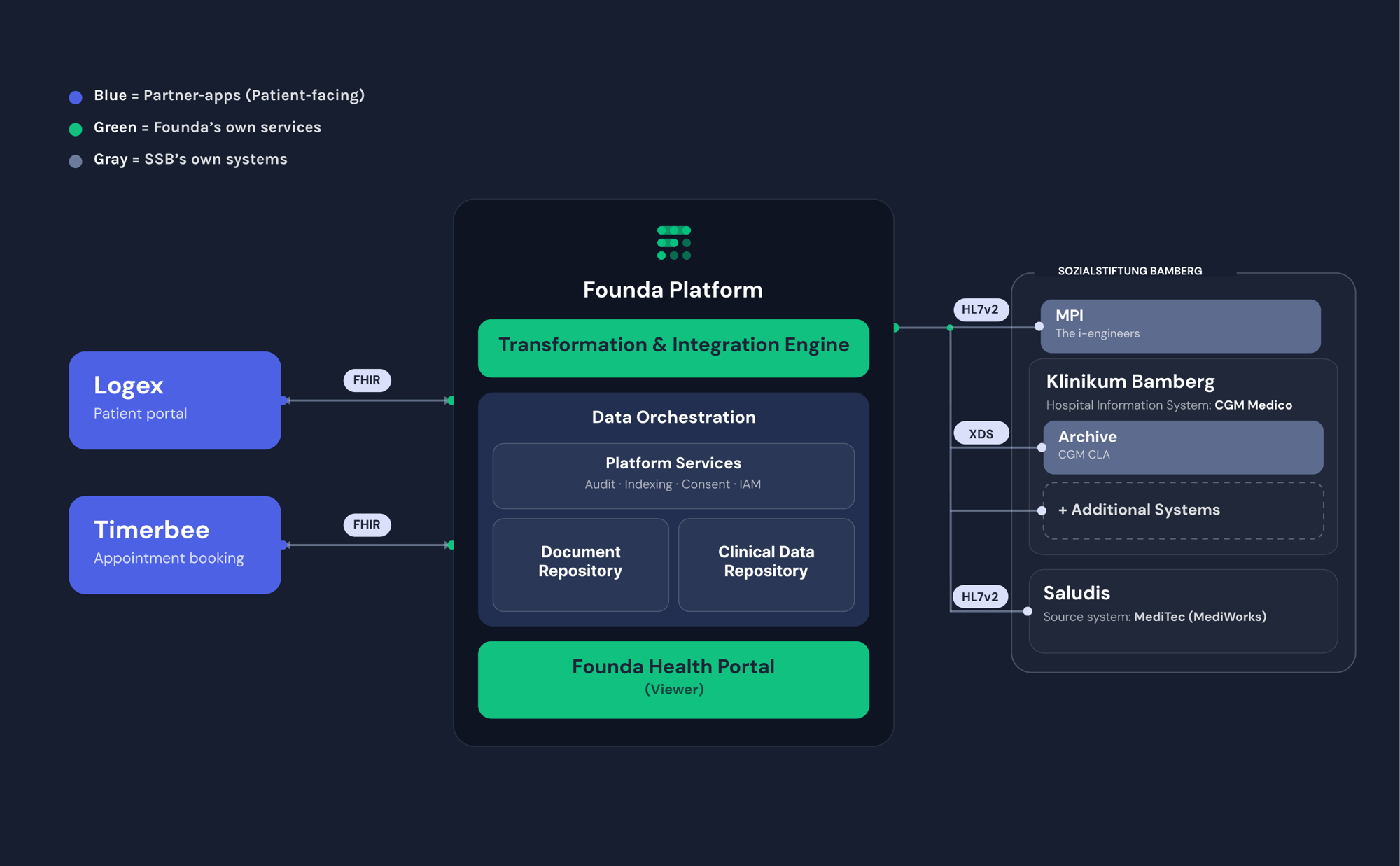
- Founda Health as the interoperability backbone, connecting the hospital's existing systems with the new patient-facing solutions
- Logex providing the patient portal where documents and discharge letters can be provided and appointment information lives
- Timerbee providing the appointment management system, embedded into the SSB website and consuming available appointments from the HIS
Each clinical system connects to the platform once, not to every other system individually. When a new system joins, it immediately benefits from all existing connections, leveraging the effect of growing interoperability.
Underneath, the Founda Platform connects existing clinical systems via internationally recognized healthcare standards (IHE, FHIR, HL7v2), ensuring that every system speaks about the same patient in the same way. Documents stay in their source systems and are made available wherever they are needed. Moreover, by using the existing MPI capabilities, the Founda platform enabled the SSB to connect existing hospital patient identities with respective patient portal accounts, to ensure: (1) Full control over patient identity mapping, (2) Patient identity linking directly via the Founda Health Portal, (3) Controlled document exchange based on pre-defined policies while meeting international and internal standards.
By aligning with governmental initiatives such as the Hospital Care Improvement Act (KHVVG) and the Hospital Future Fund (KHZF), this foundation supports future use cases without architectural rework, safeguarding digital investments against shifting regulations.
The Impact: From Silos to Seamless Care
In our Phase One rollout within key clinical departments, the results were immediate.
Appointment booking. Patients began booking appointments online within days, bypassing the classic telephone bottleneck. 24/7 availability for patients and a noticeable reduction in administrative effort to book and log appointments in the hospital information system. The latter was achieved through a direct ISiK interface between Timerbee and CGM Medico. As part of the booking process, patients are also invited to register in the patient portal, where they can view and manage their appointments.
Document administration. Patients create an account in the portal and upload relevant documentation themselves. Once their identity is verified, administrative staff at the SSB link the portal account with the existing clinical identity. Pre-defined medical documents from the connected CGM CLA archive can be retrieved in the patient portal, while clinical personnel see patient-shared documents in real time. To provide a tangible example of this direct value: SSB can now make PDF documents containing personalised QR codes for radiology images accessible directly in the patient portal. Patients can then access their images instantly. All this without relying on CDs, manual workflows at the radiology desk, or printed documents.
Cross-sector referrals to rehabilitation. The social services team creates digital referrals to the in-house rehabilitation institution Saludis directly in the Founda Health Portal. Staff at Saludis see the referral and the relevant documents in real time, and acceptance happens digitally. The workflow stays in one place across both organizations. The relevant admission data is transferred automatically to MediWorks, the primary system of Saludis, once the referral is completed.
Because these workflows are interlocked, they are not perceived as separate tools. Patients and hospital staff experience one unified journey from booking through discharge to rehabilitation.
Together, we didn't just add digital tools to the Sozialstiftung Bamberg’s system landscape. We removed the friction between them. Less administrative burden for staff, shorter communication cycles, and a proven first step toward genuinely paperless workflows.
The impact we've driven since going live:
159
283
140
130
187K
30K
Looking Ahead
Phase One is the foundation, not the destination. Workflows already mapped or in design include:
- Expanded referral network for external physicians needing secure access to relevant patient records
- Rolling out additional care paths to strengthen the capabilities of the patient portal
- Data-driven clinical insights based on FHIR-structured data, opening the door to population health analytics and long-term outcome tracking
- Further cross-sector workflows extending the digital referral pattern beyond rehabilitation to other care partners
Even in one of the most complex regulatory environments in Europe, connected and patient-centered care is achievable. All it takes is the right strategy, the right foundation, and the right partners.
About Founda Health
Founda Health enables secure, standards-based availability of healthcare data between organizations and systems. The Founda Platform helps healthcare networks connect existing infrastructure, support national interoperability initiatives, and prepare for future European requirements around data sharing and consent.