Auto Reconcile
External imaging, reconciled from the moment it arrives.
Auto Reconcile matches external study retrieved from the connected networks to a local order, patient, and report in a single action. Less manual work across departments, no more studies falling through the cracks, and one consistent approach to external imaging across your entire hospital.
In many hospitals, radiology teams lose hours every week before an external study is ready to read.
Importing external imaging through external networks involves more manual steps than it should. Studies arrive but they don't automatically match to a local patient, order, or report. The gap between "available to export" and "ready to read in PACS" is filled with manual work.
Reconciliation depends on manual effort
A clinician creates the order in the EMR, matches the accession number, and copy-pastes the report. Every external study. Every time. That adds up to roughly 20 minutes of manual work per patient.
Imaging studies get stuck in error queues
When patient or procedure data doesn't match, studies sit unlinked. Not visible in the workflow, not available for reading, and not billable. The team doesn't always know until something is missing.
PACS is no longer a reliable single source of truth
When reports and images end up disconnected, clinicians can't rely on PACS at the point of care. Incomplete care product registration can also mean procedures aren't billed correctly.
The operational cost of manual reconciliation
~20
The end-to-end manual reconciliation workload for a single external study, from raising the order in the EMR to verifying the study is visible in PACS.
~66
At 200 external patients per month, a single PACS administrator spends nearly two full working weeks on manual reconciliation. Staff time that cannot be reallocated to anything else.
4
Every external study today requires a medical assistant, a clinician, and a PACS admin to each take a manual step before the study is ready to read.
* These figures are directional benchmarks derived from PACS administrator field research and internal analytics. Results will vary depending on organisation size, patient volume, and existing workflows.
Introducing Auto Reconcile
One configurable action. The right outcome, every time.
Auto Reconcile is a Capability on the Founda Health Portal that handles the entire import reconciliation flow from a single action. The user selects an external study and confirms a small set of values. From there, the system takes over. The result is an external study that behaves exactly like a locally acquired one inside PACS, stored and governed by the hospital's own retention rules, with the order, report, and images all properly linked from the start. It is a configurable Capability on the Founda platform. Each customer's setup is managed through the Integration Engine. No custom code. No bespoke builds.


The Hidden Cost of Manual Preparation
Clinical capacity is lost when systems are not ready at the point of care. Today, imaging readiness depends on manual workarounds that erode clinical throughput:
- Manual Burden: Staff spend ~15 minutes per patient searching for and importing external studies.
- Workflow Friction: PACS administrators spend ~20 minutes per patient reconciling studies to local orders.
- Information Overload: Growing national availability has scaled faster than filtering maturity, leading to "review inflation" and cognitive load.
Auto Reconcile: In action, Integrated into your existing workflow
Select an external study
The user finds an externally available study in the Founda Health Portal and initiates import with a single action.
Confirm reconciliation details
A short form shows existing DICOM metadata alongside configurable fields. The user confirms or corrects procedure code, modality, and optional fields before submitting.

Order created automatically
Founda generates a unique local accession number and creates the radiology order in the EMR via HL7. No manual entry required.
Report delivered to the EMR
The report is pulled from the external network and carried in the same HL7 message. If no report is yet available, a standard placeholder is used to keep the order complete.
Images land in PACS, linked to order
DICOM images are sent to PACS with the matching accession number. PACS links them to the order automatically. The study is ready to read, like any locally acquired one.
Avoiding duplicate records
An optional pre-import check flags studies already present in PACS. Patient identifiers are resolved via FHIR PIX, so the right local patient ID is always used.
Consistent reconciliation changes what is possible for every team.
By collapsing a multi-step manual process into a single platform action, Auto Reconcile removes the operational friction and makes it possible to scale consistently across every department.
Radiology & PACS operations
No more studies stuck in error queues, no more accession creation and matching, no more chasing down missing reports. External studies arrive in PACS reconciled and ready to read, every time.

Enterprise IT architecture
One supported Capability on the Founda platform replaces brittle, customer-specific forms. Configuration instead of custom code: maintainable, extendable, and consistent across sites.
Clinicians & radiologists
External studies appear in PACS as local ones, complete with the right order, patient ID, and report. PACS becomes a trustworthy single source of truth at the point of care.
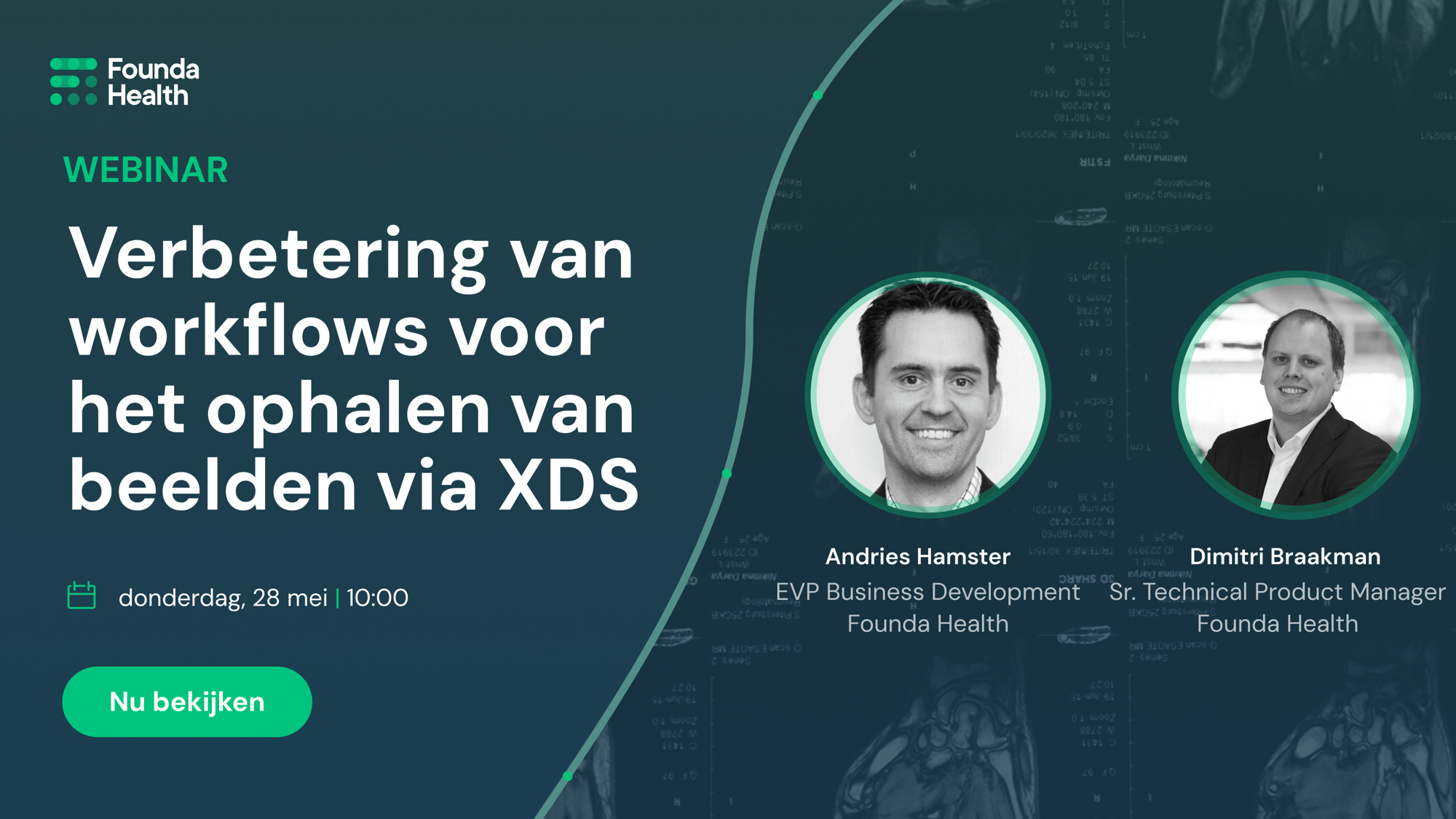
Upcoming webinar (Dutch)
Improving workflows for retrieving images via XDS
Every month, healthcare organizations retrieve large volumes of imaging data through XDS networks, often relying on manual and time-intensive processes. This session walks through the image retrieval workflow step by step, highlighting where bottlenecks occur and how they impact staff time and operational efficiency.
Learn how Founda’s Auto Reconcile and Image Prefetch capabilities automate these workflows end to end, reducing manual effort and improving consistency. The session includes live demonstrations and practical guidance to help you evaluate next steps for optimizing your workflows.
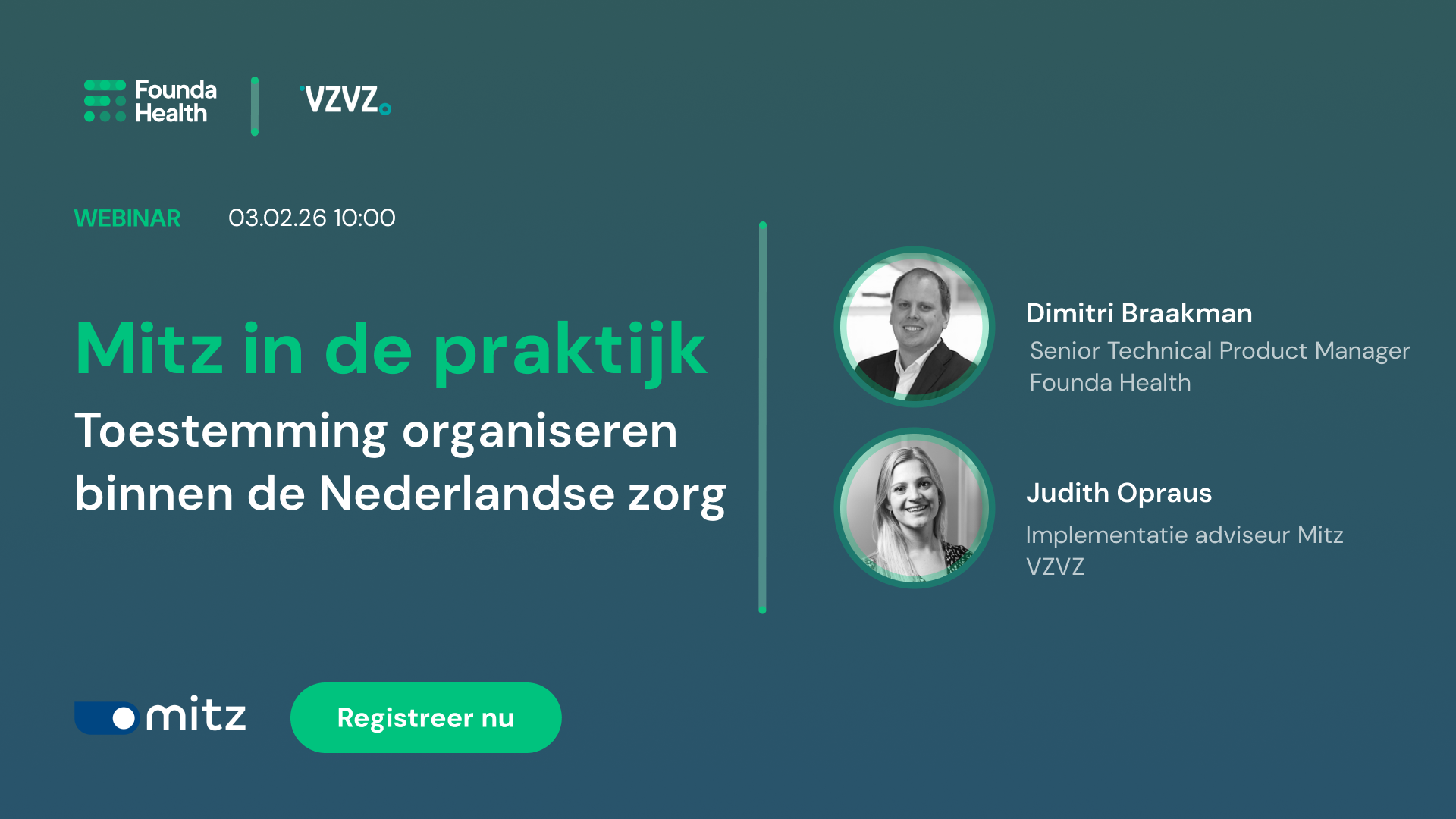
Mitz webinar
Leer van praktijkervaringen
De voorbereiding op Mitz roept bij veel zorgorganisaties praktische vragen op, bijvoorbeeld hoe het past in de dagelijkse bedrijfsvoering en bestaande uitwisselingsinfrastructuren.
In ons komende webinar lopen VZVZ en Founda stap voor stap door Mitz heen, met een praktische focus op hoe het kan worden georganiseerd binnen het huidige landschap van informatie-uitwisseling in de zorg.
- VZVZ legt uit wat Mitz is, waarom het is ontwikkeld en welke rol het speelt binnen het Nederlandse zorglandschap.
- Founda laat zien hoe de Founda Mitz Connector kan worden geïntegreerd in bestaande XDS-gebaseerde uitwisselingsworkflows zonder dat er extra systemen nodig zijn of de bedrijfsvoering wordt verstoord.
Deze sessie is bedoeld voor zorgorganisaties die beter willen begrijpen hoe Mitz kan worden geïmplementeerd binnen hun bestaande infrastructuur en zich willen voorbereiden op toekomstige ontwikkelingen op het gebied van toestemming van patiënten.
.png?width=2000&height=1125&name=V2-%20Speaker%20graphic%20webinar%20-%20nl%20(1).png)